The Art Work of Louis C Tiffany by Charles De Kay
| Louis Condolement Tiffany | |
|---|---|
 Tiffany c. 1908 | |
| Built-in | (1848-02-18)February eighteen, 1848 New York City, U.S. |
| Died | January 17, 1933(1933-01-17) (anile 84) New York City, U.S. |
| Resting place | Light-green-Forest Cemetery |
| Teaching | Pennsylvania Military Academy Eagleswood Military Academy |
| Known for | Favrile glass, Tiffany lamps |
| Spouse(southward) | Mary Woodbridge Goddard (1872–1884; her death) Louise Wakeman Knox (1886–1904; her decease) |
| Children | Dorothy Burlingham and seven others |
| Parent(s) | Charles Lewis Tiffany Harriet Olivia Avery Young |
| Signature | |
 | |
Louis Condolement Tiffany (Feb eighteen, 1848 – January 17, 1933) was an American creative person and designer who worked in the decorative arts and is best known for his work in stained glass. He is the American artist most associated with the Art Nouveau[1] and Aesthetic movements. He was affiliated with a prestigious collaborative of designers known as the Associated Artists, which included Lockwood de Wood, Candace Wheeler, and Samuel Colman. Tiffany designed stained drinking glass windows and lamps, drinking glass mosaics, blown drinking glass, ceramics, jewellery , enamels, and metalwork.[2] He was the first pattern manager at his family company, Tiffany & Co., founded by his male parent Charles Lewis Tiffany.
Early life [edit]
Louis Comfort Tiffany was born in New York City, the son of Charles Lewis Tiffany, founder of Tiffany and Company, and Harriet Olivia Avery Young. He attended school at Pennsylvania Military Academy[3] in Westward Chester, Pennsylvania, and Eagleswood Armed services University in Perth Amboy, New Jersey. His first artistic grooming was as a painter, studying nether George Inness in Eagleswood, New Bailiwick of jersey and Samuel Colman in Irvington, New York. He likewise studied at the National Academy of Design in New York Urban center in 1866–67 and with salon painter Leon-Adolphe-Auguste Abdomen in 1868–69. Belly'south landscape paintings had a great influence on Tiffany.[4]

Tiffany'south 1873 painting Market place Day Outside the Walls of Tangiers, Morocco
Career [edit]
Tiffany started out as a painter, only became interested in glassmaking from well-nigh 1875 and worked at several glasshouses in Brooklyn between and so and 1878. In 1879 he joined with Candace Wheeler, Samuel Colman, and Lockwood de Forest to form Louis Comfort Tiffany and Associated American Artists. The business concern was brusk-lived, lasting but four years. The group fabricated designs for wallpaper, article of furniture, and textiles. He later opened his ain glass manufactory in Corona, New York, adamant to provide designs that improved the quality of contemporary glass.[5] Tiffany'south leadership and talent, besides as his begetter's money and connections, led this business to thrive.
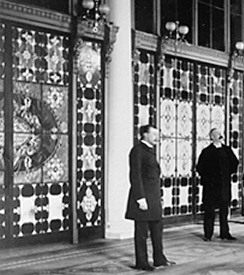
The Anteroom of the White Business firm in 1882, showing the newly installed Tiffany glass screens

In 1881 Tiffany did the interior pattern of the Marking Twain House in Hartford, Connecticut, which nonetheless remains, but the new firm's most notable work came in 1882 when President Chester Alan Arthur refused to move into the White Firm until it had been redecorated. He commissioned Tiffany, who had begun to make a proper noun for himself in New York society for the firm's interior blueprint piece of work, to redo the country rooms, which Arthur found charmless. Tiffany worked on the East Room, the Blue Room, the Red Room, the State Dining Room, and the Entrance Hall, refurnishing, repainting in decorative patterns, installing newly designed mantelpieces, irresolute to wallpaper with dense patterns, and, of course, adding Tiffany drinking glass to gaslight fixtures and windows and calculation an opalescent flooring-to-ceiling glass screen in the Entrance Hall.[half dozen] [7] [8] The Tiffany screen and other Victorian additions were all removed in the Roosevelt renovations of 1902, which restored the White House interiors to Federal manner in keeping with its compages.[9]
A want to concentrate on art in glass led to the breakup of the firm in 1885 when Tiffany chose to constitute his own glassmaking firm that same year. The first Tiffany Glass Visitor was incorporated December 1, 1885, and in 1902 became known every bit the Tiffany Studios.
In the starting time of his career, Tiffany used cheap jelly jars and bottles because they had the mineral impurities that finer drinking glass lacked. When he was unable to convince fine glassmakers to go out the impurities in, he began making his own drinking glass. Tiffany used opalescent glass in a diverseness of colors and textures to create a unique fashion of stained glass. Tiffany acquired Stanford Bray's patent (https://patents.google.com/patent/US349424A/en)for the "copper foil" technique, which, by edging each slice of cut drinking glass in copper foil and soldering the whole together to create his windows and lamps, made possible a level of particular previously unknown. This can be contrasted with the method of painting in enamels or glass paint on colorless glass, and and then setting the glass pieces in lead channels, that had been the dominant method of creating stained glass for hundreds of years in Europe.
The First Presbyterian Church building of 1905 in Pittsburgh, Pennsylvania, is said to be unique in that information technology uses Tiffany windows that partially brand use of painted glass.[ dubious ] Use of the colored glass itself to create stained drinking glass pictures was motivated past the ideals of the Arts and Crafts movement and its leader William Morris in England. Beau artists and glassmakers Oliver Kimberly and Frank Duffner, founders of the Duffner and Kimberly Company and John La Farge were Tiffany's main competitors in this new American style of stained drinking glass. Tiffany, Duffner and Kimberly, along with La Farge, had learned their craft at the same glasshouses in Brooklyn in the late 1870s.
In 1889 at the Paris Exposition, Tiffany was said to have been "overwhelmed" past the glass work of Émile Gallé, French Art Nouveau artisan.[10] He as well met artist Alphonse Mucha.
In 1893, Tiffany congenital a new factory called the Stourbridge Glass Company, later called Tiffany Drinking glass Furnaces, which was located in Corona, Queens, New York, hiring the Englishman Arthur J. Nash to oversee it.[11] In 1893, his company also introduced the term Favrile in conjunction with his outset production of blown glass at his new glass factory. Some early examples of his lamps were exhibited in the 1893 Globe'southward Fair in Chicago. At the Exposition Universelle (1900) in Paris, he won a golden medal with his stained glass windows The Iv Seasons
He trademarked Favrile (from the erstwhile French discussion for handmade) on Nov 13, 1894. He after used this word to utilise to all of his glass, enamel and pottery. Tiffany's first commercially produced lamps date from effectually 1895. Much of his company's production was in making stained drinking glass windows and Tiffany lamps, only his company designed a complete range of interior decorations. At its peak, his factory employed more than than 300 artisans. Recent scholarship led by Rutgers professor Martin Eidelberg suggests that a team of talented single women designers – sometimes referred to equally the "Tiffany Girls"[12] – led by Clara Driscoll played a large part in designing many of the floral patterns on the famous Tiffany lamp too as for other creations.[13] [fourteen] [15] [16] [17]
Tiffany interiors also made considerable use of mosaics. The mosaics workshop, largely staffed by women, was overseen until 1898 by the Swiss-built-in sculptor and designer Jacob Adolphus Holzer.
In 1902, Tiffany became the first Design Manager for Tiffany & Co., the jewelry visitor founded by his father.[18]
1911 saw the installation of an enormous drinking glass pall fabricated for the Palacio de Bellas Artes in Mexico City. It is considered by some to be a masterpiece.[ten]

Louis Comfort Tiffany (far left) with his parents (seated), pictured property Tiffany'south twin daughters Louise and Julia

Tiffany Studios Daffodil stained glass leaded lampshade, now known to exist one of head designer Clara Driscoll'due south creations
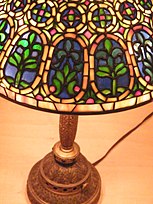
Shut-up of a Tiffany Studios "Venetian" desk lamp, c. 1910–20
Tiffany used all his skills in the pattern of his own house, the 84-room Laurelton Hall, in the hamlet of Laurel Hollow, on Long Island, New York, completed in 1905. Subsequently this estate was donated to his foundation for art students along with lx acres (243,000 grandii) of land, sold in 1949, and destroyed by a burn down in 1957.[xix]
Personal life [edit]
Louis married Mary Woodbridge Goddard (c1850-1884) on May 15, 1872 in Norwich, Connecticut and had the following children:
- Mary Woodbridge Tiffany (1873–1963) who married Graham Lusk;[20]
- Charles Louis Tiffany I (1874–1874);
- Charles Louis Tiffany Two (1878–1947) who married Katrina Brandes Ely; and
- Hilda Goddard Tiffany (1879–1908), the youngest.
After the death of his wife, he married Louise Wakeman Knox (1851–1904) on Nov ix, 1886. They had the following children:
- Louise Comfort Tiffany (1887–1974), who married Rodman Drake DeKay Gilder;
- Julia DeForest Tiffany (1887–1973), who married Gurdon S. Parker so married Francis Minot Weld;[21]
- Annie Olivia Tiffany (1888–1892); and
- Dorothy Trimble Tiffany (1891–1979), who, as Dorothy Burlingham, subsequently became a noted psychoanalyst and lifelong friend and partner of Anna Freud.

Tiffany died on January 17, 1933, and is buried in Greenish-Forest Cemetery in Brooklyn, New York.[22]
Tiffany is the great-granddaddy of investor George Gilder.
Societies [edit]
- American Watercolor Social club
- Architectural League
- Chevalier of the Legion of Honour in 1900
- Purple Society of Fine Arts (Tokyo)
- National Academy of Design in 1880
- New York Society of Fine Arts
- Société Nationale des Beaux-Arts (Paris)
- Society of American Artists in 1877[ commendation needed ]
Source:[22]
Awards and honors [edit]
- 1893: 44 medals, Globe Columbian Exposition (Chicago)
- 1900: gold medal, Chevalier of the Legion of Honour (France)
- 1900: yard prix, Paris Exposition
- 1901: grand prix, St. Petersburg Exposition
- 1901: gold medal, Buffalo Exposition
- 1901: aureate medal, Dresden Exposition
- 1902: gold medal and special diploma, Turin Exposition
- 1904: gold medal, Louisiana Purchase Exposition in St. Louis[23]
- 1907: gold medal, Jamestown Exposition
- 1909: grand prize, Seattle Exposition
- 1915: gold medal, Panama Exposition
- 1926: gold medal, Philadelphia Sesquicentennial Exposition
Source:[22]
Collections [edit]
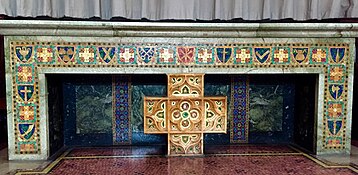
The Charles Hosmer Morse Museum of American Fine art in Winter Park, Florida houses the world's almost comprehensive collection of the works of Louis Comfort Tiffany, including Tiffany jewelry, pottery, paintings, fine art glass, leaded-glass windows, lamps, and the Tiffany Chapel he designed for the 1893 World'southward Columbian Exposition in Chicago. Subsequently the close of the exposition, a benefactor purchased the entire chapel for installation in the catacomb of the Cathedral of Saint John the Divine, New York in New York City. Equally construction on the cathedral continued, the chapel fell into disuse, and in 1916, Tiffany removed the bulk of it to Laurelton Hall. After a 1957 fire, Hugh McKean[24] (a sometime art student in 1930 at Laurelton Hall) and his wife Jeannette Genius McKean rescued the chapel,[25] which now occupies an entire wing of the Morse Museum which they founded. Many glass panels from Laurelton Hall are likewise at that place; for many years some were on display in local restaurants and businesses in Central Florida. Some were replaced by full-scale color transparencies after the museum opened.
A major exhibit at New York's Metropolitan Museum of Fine art on Laurelton Hall opened in Nov 2006. An showroom at the New-York Historical Guild in 2007 featured new information about the women who worked for Tiffany and their contribution to designs credited to Tiffany; the Society holds and exhibits a major drove of Tiffany's work. In improver, since 1995 the Queens Museum of Art has featured a permanent collection of Tiffany objects, which continues Tiffany'due south presence in Corona, Queens where the company's studios were once located. Reid Memorial Presbyterian Church building in Richmond, Indiana has a collection of 62 Tiffany windows which are notwithstanding their original placements, but the church building is deteriorating and in jeopardy.
In 1906, Tiffany created stained glass windows for the Stanford White-designed Madison Square Presbyterian Church located on Madison Artery in Manhattan, New York Urban center. The church building was Tiffany'due south identify of worship, and was torn downward in 1919 after the Metropolitan Life Insurance Company bought the country to build their new headquarters. Tiffany had inserted a clause in his contract stipulating that if the church building were ever to be demolished and then ownership of the windows would revert to him.[ commendation needed ]
Tiffany enjoyed staying at the Mission Inn in Riverside, California, and had become friends with the founder of the Mission Inn, Frank Augustus Miller, so, after meeting with Miller in New York, Tiffany shipped the windows to the Mission Inn; they arrived there in 1924,[26] and were stored until the inn's St. Francis Chapel was completed in 1931. There are half dozen rectangular windows and a 104" diameter window in the rear of the chapel, as well equally another 104" diameter window is in the Galeria next to the chapel. A smaller window entitled "Monk At The Organ" featuring a Franciscan friar, is in St Cecelia's Chapel, a wedding chapel, and is engraved with Tiffany's signature. The St Francis Chapel was designed with the intent of prominently displaying Tiffany'southward windows.[27]
The Arlington Street Church in Boston has sixteen Tiffany windows of a prepare of 20, designed by Frederick Wilson (1858–1932), Tiffany's primary designer for ecclesiastical windows.[28] They were gradually installed between 1889 and 1929. The church building archives include designs for 4 additional windows, which were never commissioned due to financial constraints caused by the Not bad Depression.[29] When funds again became available, Tiffany Studios had gone out of business and its stockpile of glass had been dispersed and lost, ending the prospect of completing the gear up.[29] Also in the Back Bay commune of Boston is Frederick Ayer Mansion, one of three surviving examples of Tiffany interiors, and the only surviving edifice besides possessing exterior mosaics designed by Tiffany.[30]
The Pine Street Baptist Church building in Providence, Rhode Island was opened in 1917 at Lloyd and Wayland Street equally Primal Baptist and in 2003, became known as Community Church building of Providence. Between 1917 and 2018 the church featured a big Tiffany stained drinking glass memorial to Frederick Westward. Hartwell that was created by Agnes F. Northrop[31] and entitled "Low-cal in Heaven and Earth". The circuitous work, considered "i of the largest and finest landscape windows ever produced past Tiffany Studios", largely was overlooked in the community. In 2018, the church building sold the window to the Art Constitute of Chicago. Later on conservation and training information technology will be displayed prominently as the Hartwell Memorial Window.[32]
Meaning collections of Tiffany windows outside the United States are the 17 windows in the sometime Erskine and American United Church, now function of the Montreal Museum of Fine Arts in Montreal, Canada,[33] and the two windows in the American Church in Paris, on the Quai d'Orsay, which have been classified equally National Monuments by the French authorities; these were commissioned by Rodman Wanamaker in 1901 for the original American Church on the right banking company of the Seine.
The Haworth Art Gallery in Accrington, England[34] contains a collection of more than 140 examples of the piece of work of Louis Comfort Tiffany, including vases, tiles, lamps, and mosaics. The collection, which claims to be the largest collection of publicly owned Tiffany glass exterior of the Us, contains a fine example of an Aquamarine vase and the noted Sulphur Crested Cockatoos mosaic.
Gallery [edit]
- Stained glass windows
-

-

Daughter with Cherry Blossoms (c. 1890)
-

The Tree of Life stained glass
-

-
-
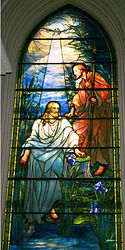
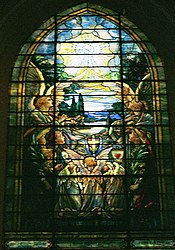
The Baptism of Christ, at Brown Memorial
-

Nicodemus Came to Him by Night, Beginning Presbyterian Church, Lockport, NY
-
-
-

- Tiffany Lamps
-

Wisteria Table Lamp
See besides [edit]
- Tiffany drinking glass
- The Louis Comfort Tiffany Foundation
- Art Nouveau drinking glass art
References [edit]
Notes
- ^ Lander, David. "The Buyable Past: Quezal Glass" Archived August 29, 2008, at the Wayback Auto American Heritage (Apr/May 2006)
- ^ Warmus, William. The Essential Louis Condolement Tiffany. New York: Abrams, 2001. Pages 5–8.
- ^ "Widener University: Distinguished Alumni". Widener University. Archived from the original on July 20, 2008. Retrieved Oct 6, 2008.
- ^ Baal-Teshuva, Jacob. Louis Condolement Tiffany. Taschen. pp. 12–14.
- ^ Baal- Teshuva, Jacob. Louis Condolement Tiffany. Taschen. pp. 22–xxx.
- ^ "Victorian Ornamentation" on WhiteHouseMuseum.org
- ^ "White House Timelines: Architecture" Archived Jan 17, 2011, at the Wayback Machine on the White House Historical Association website
- ^ "White House Timelines: Decorative Arts" Archived Oct 19, 2010, at the Wayback Auto on the White House Historical Association website
- ^ "Theodore Roosevelt Renovation, 1902". The White House Museum. Retrieved December 12, 2013.
- ^ a b Encyclopædia Britannica
- ^ Campell, Gordon, ed. (2006). "Encyclopedia of Decorative Arts, vol. 2, pp. 464". Oxford University Printing.
- ^ Gafffney, Dennis "Who Were the Tiffany Girls?" Antiques Roadshow website (January 12, 2015)
- ^ Taylor, Kate (February 13, 2007). "Tiffany's Secret Is Over". New York Sun . Retrieved November 16, 2009.
- ^ Johnson, Caitlin A. (April 15, 2007). "Tiffany Drinking glass Never Goes Out Of Mode". CBS News . Retrieved November 16, 2009.
- ^ Kastner, Jeffrey (February 25, 2007). "Out of Tiffany'due south Shadow, a Adult female of Light". The New York Times . Retrieved November 16, 2009.
- ^ Goodman, Vivian (January 14, 2007). "Exhibition Honors Woman Behind the Tiffany Lamp". NPR . Retrieved November 16, 2009.
- ^ "Spare Times". The New York Times. April 7, 2006. Retrieved November 16, 2009.
- ^ "Louis Condolement Tiffany" on the Tiffany & Co. website
- ^ "Laurelton Hall, Louis Comfort Tiffany's Long Isle estate". world wide web.morsemuseum.org . Retrieved February four, 2019.
- ^ Pennoyer, Peter; Walker, Anne; Stern, Robert A. Thousand. (2009). The Compages of Grosvenor Atterbury. W. Westward. Norton & Company. p. 270. ISBN9780393732221 . Retrieved January xxx, 2019.
- ^ "Mrs. Parker Weds Francis M. Weld". The New York Times. August 18, 1930.
- ^ a b c "Louis C. Tiffany, Noted Artist, Dies" New York Times (January eighteen, 1933)
- ^ Frelinghuysen, Alice Cooney; Obniski, Monica. "Louis Comfort Tiffany (1848–1933)". The Metropolitan Museum of Art . Retrieved July 31, 2013.
- ^ Hugh McKean
- ^ Jeannette Genius McKean
- ^ Riverside Daily Press (June 12, 1924)
- ^ Lech, Steve (2005). Riverside in Vintage Postcards. Arcadia Publishing. p. 66. ISBN978-0-7385-2978-3.
the Saint Francis Chapel had to exist specially designed to business firm them
- ^ "About Tiffany Windows". ASC Tiffany. Foundation for the Preservation of 20 Arlington Street. Retrieved May sixteen, 2017.
- ^ a b "Our Windows: A Guide to the Historic Collection of Tiffany Windows" (PDF). Arlington Street Church. Arlington Street Church building. Retrieved May 16, 2017.
- ^ "NHL nomination for Frederick Ayer Mansion" (PDF). National Park Service. Retrieved May 30, 2014.
- ^ McGreevy, Nora, Stunning Tiffany Stained Glass Debuts Subsequently 100 Years of Obscurity, Smithsonian Mag, May 28, 2021
- ^ Naylor, Donita (Feb 21, 2020). "Tiffany church building window, unnoticed in Providence, volition be a star allure in Chicago art museum". The Providence Journal. Archived from the original on February 23, 2020. Retrieved February 23, 2020.
- ^ Mathieu, Christine Johanne. The History of the Tiffany Windows at the Erskine and American Church, Montreal Concordia University (Master of Arts Thesis), 1999
- ^ "Haworth Fine art Gallery" on the Hyndburn Borough Quango website
Sources
- Tiffany, Louis Comfort & de Kay, Charles. The Art Work of Louis C. Tiffany. Doubleday, Page & Co, New York, 1916
Further reading
- Couldrey, Vivienne. The Art of Louis Condolement Tiffany. Bloomsbury Publications, London, 1989, ISBN 0-7475-0488-1
- Duncan, Alastair. Tiffany Windows. Thames & Hudson, London, 1980, ISBN 978-0-500-23321-4
- Frelinghuysen, Alice Cooney (2006). Louis Comfort Tiffany and Laurelton Hall: an artist'southward state manor. New York: The Metropolitan Museum of Fine art. ISBN1588392015.
- Koch, Robert H. Louis C. Tiffany – Rebel in Glass. tertiary Ed., Crown Publishers Inc, New York, 1982, ASIN B 0007DRJK0
- Logan, Ernest Edwin. The Church That Was Twice Born: A History of the Beginning Presbyterian Church Of Pittsburgh, Pennsylvania 1773–1973. Pickwick-Morcraft, Pittsburgh, Pa., 1973
- Rago, David. "Tiffany Pottery" in American Art Pottery. Knickerbocker Press, New York, 1997
- "Featured Windows, Louis C. Tiffany and Tiffany Studios As Seen Through Michigan Stained Glass Windows". Michigan Stained Glass Census. May–June 2008. Retrieved February xviii, 2012.
External links [edit]
- Tiffany Digital Collection from the Metropolitan Museum of Fine art Libraries
- Tiffany Treasures: Favrile Drinking glass from Special Collections. Information on the 2009–2010 exhibition at The Corning Museum of Glass.
- Louis Comfort Tiffany – Artist and Man of affairs
- Louis Condolement Tiffany at Find a Grave
- Louis Condolement Tiffany objects in the collection of the Cooper-Hewitt, National Design Museum
- Louis Comfort Tiffany Pictorial Histories
- Press Release on Metropolitan 2006–07 exhibition nigh Laurelton Hall
- Tiffany and The Associated Artists' work on the Marker Twain Business firm
- When Louis Tiffany Redesigned the White House
- Willard Memorial Chapel
- Virtual visit of Tiffany Glass exhibit at the Montreal Museum of Fine Arts (2010).
- Tiffany windows at Reid Memorial Presbyterian Church in Richmond, Indiana.
- Ayer Mansion, Back Bay, Boston (now Bayridge Residence and Cultural Center)
- Artwork by Louis Comfort Tiffany
buckleyproppracted.blogspot.com
Source: https://en.wikipedia.org/wiki/Louis_Comfort_Tiffany
0 Response to "The Art Work of Louis C Tiffany by Charles De Kay"
Post a Comment